
Most teams evaluate SEO through rankings, traffic growth, and visibility. These metrics look good on dashboards. They create a strong perception of progress.
But here’s the contradiction. Companies see consistent SEO growth while revenue stays flat. This isn’t an execution problem. It’s structural. This article explains why SEO metrics improve without impacting revenue. We’ll also show how different agencies approach solving this gap.
SEO Performance Exists Inside Its Own System
SEO operates as a self-contained system. Rankings, impressions, and sessions become the primary indicators of success. Teams celebrate when these numbers go up.
These metrics are internally consistent. But they disconnect from business performance. Teams optimize for what they can measure easily, not for what drives revenue. That’s where the problem begins.
Why Traffic Growth Does Not Equal Revenue Growth
Traffic growth gets mistaken for business growth all the time. Not all traffic has the same value. High-volume keywords often bring low-intent users who are unlikely to convert.
According to our data, this problem shows up in predictable patterns. Keyword research ignores commercial intent. Reporting celebrates session increases without asking whether those visitors actually convert.
Key reasons why SEO growth fails to translate into revenue:
- Focus on traffic volume instead of purchase or conversion intent;
- Keyword strategies built around search demand rather than business value;
- Growth concentrated on informational queries instead of transactional ones;
- No prioritization based on revenue potential or margin impact;
- Lack of connection between SEO and actual conversion behavior.
Traffic growth without intent alignment leads to flat revenue outcomes.
Where the Real Disconnect Happens Inside SEO Systems
The main issue isn’t visibility. It’s missing connections between systems. SEO, analytics, CRM, and sales operate separately. Without integration, SEO cannot influence revenue directly.
We see this constantly. A company ranks for strong keywords. Traffic flows in. But nobody connects that traffic to the pipeline because there is no link between SEO performance and CRM data.
Core structural gaps that break the revenue connection:
- No integration between SEO data and CRM or sales pipeline systems;
- Reporting focused on rankings instead of revenue contribution numbers;
- Absence of forecasting tied to business metrics like CAC or LTV;
- Lack of product or service-level performance analysis in SEO work;
- Disconnection between SEO strategy and conversion optimization efforts.
Without these connections, SEO remains a reporting function. It never becomes a growth driver.
What SEO Looks Like When It Is Built Around Revenue
Solving this problem requires rebuilding SEO as a revenue system. SEO must connect to intent, conversions, and financial outcomes from the start. Most agencies can’t do this because they’ve never built those connections.
Core elements of a revenue-driven SEO system:
- Forecasting based on conversion rates and revenue potential per keyword;
- Keyword prioritization driven by commercial intent and business value;
- Direct integration with CRM, analytics platforms, and sales data;
- Continuous optimization based on conversion performance, not rankings;
- Attribution mapping between SEO efforts and closed revenue outcomes.
This approach transforms SEO into a measurable and scalable growth channel. It’s harder to build. But it actually works.
5 SEO Agencies That Approach Growth Through Revenue
These companies represent different ways of approaching SEO. This is not a popularity ranking. Each solves the same core problem by connecting SEO to revenue in a different way.
1. Seoprofy
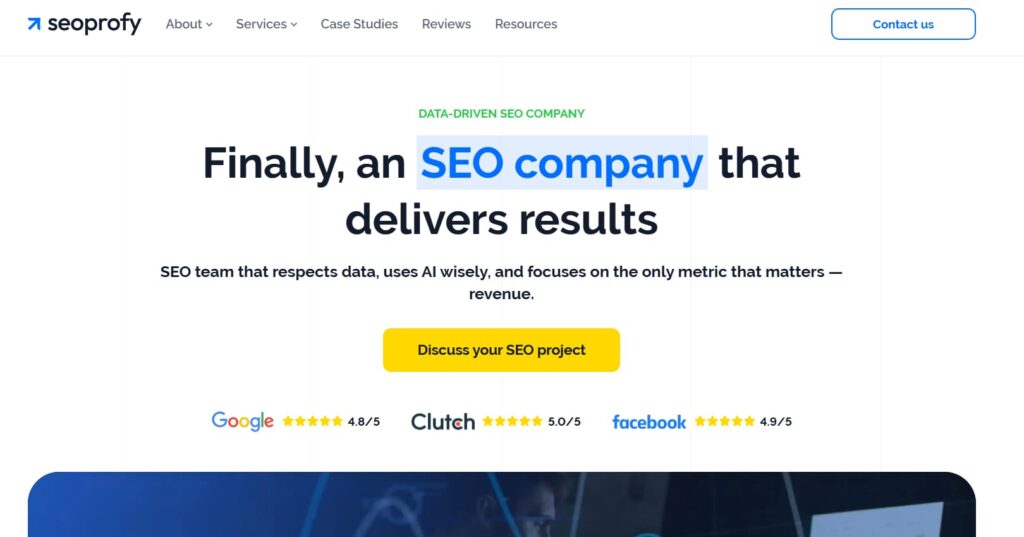
Seoprofy builds SEO as a revenue-first system. They focus on forecasting, ROI, and measurable outcomes. According to our analysts, their approach works especially well for enterprise and SaaS clients.
Building SEO Systems Around Revenue
Their system starts with financial impact. Forecasting happens before any execution. They prioritize keywords based on revenue potential, not search volume. Proprietary tools like SearchAnalytics help them cut through noise.
Core elements of their approach:
- Forecast-driven SEO planning tied directly to revenue targets;
- Data-based decision making using real performance signals;
- Proprietary tools like SearchAnalytics for task prioritization;
- Focus on conversions and business KPIs instead of rankings;
- Continuous optimization loop based on actual revenue outcomes.
This approach works best for SaaS businesses and B2B firms with measurable pipelines, especially where leads take weeks or months to close.
2. SEO.co

SEO.co focuses on authority and link-building. Their strategies increase domain authority across competitive niches. Visibility growth comes from structured campaigns.
Building Authority That Drives Long-Term Organic Visibility
They don’t chase shortcuts. SEO.co builds link profiles that actually move the needle. Content supports organic reach at scale. Their execution models adapt to different industries.
What drives their authority model:
- Strong link-building strategies for increasing domain authority;
- Focus on scaling visibility across competitive niches;
- Content strategies supporting long-term organic growth;
- Flexible execution models across different industries;
- Emphasis on sustainable SEO growth over quick wins.
This approach is particularly relevant for companies competing in saturated markets. When competition is high, their authority-driven model helps stand out.
3. Single Grain

Single Grain connects SEO with broader marketing strategies. They don’t treat organic search as a silo. Full-funnel optimization drives their approach.
Connecting SEO With Full-Funnel Growth Strategy
Paid data informs organic strategy. Organic rankings affect paid performance. Single Grain understands this loop better than most.
How they connect channels into one growth system:
- Integration of SEO with paid and growth marketing channels;
- Focus on full-funnel optimization beyond traffic acquisition;
- Data-driven approach to campaign performance across channels;
- Experience across SaaS and ecommerce business models;
- Strategic alignment between SEO and business growth goals.
This approach works best for companies scaling across multiple acquisition channels. If you run paid, social, and organic together, they help them work as one.
4. Directive Consulting

Directive Consulting focuses on pipeline and revenue for B2B and SaaS. They don’t prioritize rankings without revenue attached. Performance marketing thinking drives their SEO work.
Aligning SEO With Pipeline and Revenue Performance
Pipeline generation is their north star. Directive integrates SEO with performance marketing. Attribution models show exactly which keywords drive closed deals.
What makes their pipeline approach different:
- Focus on pipeline generation and revenue impact, not traffic;
- Strong B2B and SaaS specialization with relevant experience;
- Integration of SEO with performance marketing campaigns;
- Data-driven decision making and multi-channel attribution;
- Alignment with sales and revenue teams from day one.
This approach works best for companies with complex sales cycles. If your deals take six months, their pipeline focus makes sense.
5. Graphite Growth

Graphite Growth applies product-led thinking to SEO. They use experimentation and growth frameworks instead of static strategies. Testing and iteration drive their execution.
Applying Product-Led Growth Thinking to SEO
They come from high-scale tech companies. Graphite treats SEO like a product. Experiments validate hypotheses. Data determines what scales.
How their experimentation model works:
- Product-led approach to SEO and growth experimentation;
- Focus on testing and iteration instead of static playbooks;
- Experience drawn from high-scale technology companies;
- Data-driven prioritization of opportunities and experiments;
- Emphasis on scalable growth systems that compound over time.
This model is most effective for startups and companies scaling aggressively. If you operate in fast-moving environments, their experimental approach fits.
How to Choose an SEO Agency That Actually Drives Revenue
Your agency choice determines whether SEO becomes a revenue driver or just a reporting system. The wrong partner sends ranking reports. The right partner asks about your conversion rates and builds forecasts.
Evaluate methodology and integration over promises. Ask about their CRM connections. Request case studies showing revenue outcomes, not traffic growth.
Key criteria to evaluate:
- Clear ability to connect SEO activities directly to revenue metrics;
- Use of forecasting and data modeling before execution starts;
- Direct integration with CRM and sales systems;
- Transparency in reporting and KPIs without hidden metrics;
- Focus on long-term business growth instead of quick wins.
These criteria help identify agencies that deliver real impact.
Final Thoughts
SEO metrics alone don’t define success. Rankings and traffic can look strong in reports, but they often reflect activity, not impact. Without a clear connection to intent, conversion, and revenue, SEO remains a visibility channel rather than a true growth driver.
The difference comes down to structure. When SEO is built around business outcomes, it starts influencing real performance. That means prioritizing what drives revenue, integrating with sales and data systems, and measuring what actually matters. The right approach doesn’t just generate traffic. It turns organic search into a predictable and scalable source of revenue.